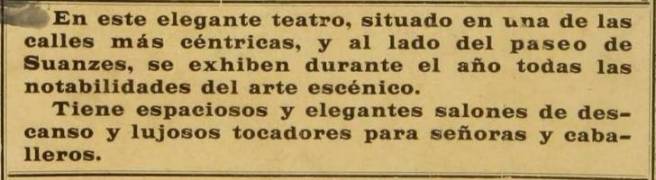
The last Town Hall plenum of June 1906 agreed to examine at its next sitting the application of Vicente Auboín Barcón for a permit to build "a wooden pavilion on the space behind the Jail for the purpose of showing films or analogous entertainment" (El Correo Gallego [ECG]. July 17, 1906, page 1).
The sitting of July 19 supplies a fuller account.
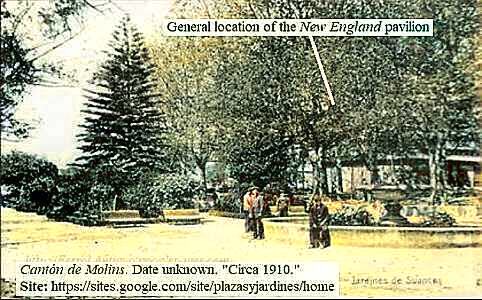
The wood pavilion was meant to have a brick foundation and its precise location would be the center of the gardens behind the Jail (behind the trees in the photograph to the right). Two appointed commissions advised Town Hall to grant the permit provided the edifice met all legal requirements covering theaters and provided the solicitor agreed to pay a rental fee of 250 Pesetas per trimester (ECG. July 20, 1906, page 2).
Town Hall handed the permit and the newspaper disclosed that the new pavilion would be named New England.
Construction began on Thursday July 26.
Construction was expected to be completed in the last days of August (ECG. July 27, 1906, page 2). "We have the best references concerning the future pavilion," the newspaper stated, "its owners do not skimp anything so customers will find a good standard of comfort inside."
The New England theater opened its doors to the public for the first time on Saturday September 15 with four shows, 6:30, 7:30, 8:30 and 10:30 PM.
The identical package of short films was shown at 6:30, 8:30 and 10:30 PM. Their titles were:
A different set was shown at 7:30 PM. The titles were:
Ticket prices for every show were 0.50 Pesetas for a padded seat with armrest, 0.30 Pesetas for sitting on a bench, 0.20 Pesetas for general admission.
El Correo Gallego was full of plaudits for the new venue of entertainment. "Great pavilion New-England" and "two grandiose programs" were regular headers during the month of October. "All the daily sessions of the New England pavilion continue to register extraordinary attendance" (ECG. October 18, 1906, page 2). "Yesterday evening, like the previous evening, an extraordinary number of people gathered in the New England pavilion to applaud the dazzling film, Un viaje a Suiza (A trip to Switzerland). A movie of similar impact will be shown today, Cristóbal Colón descubriendo las Américas " (ECG. October 19, 1906, page 2).
Some silent films shown at the pavilion linger in cyberspace. The first two beneath were shown at the New England on October 10, 1906, and the last two on December 4.
The New England was "commended to the skies" by its customers after announcing it would stage a benefit show on November 16 to succour the orphans engendered by the "woeful accident" of the 13th. The theater's box office would be handled by specially appointed commissioners, and the proceeds go directly to relieve the orphans.
On Tuesday November 13 at 9:30 AM near the Central Market "there occurred an extremely sad mishap which left a searing impression on everyone who witnessed it" (ECG. November 13, 1906, page 2). Several warehouse boys fumbled a butt barrel full of wine as they were transferring it from cart to depot on this street. The butt barrel rolled down at breakneck speed and struck three female costermongers at the bottom of the run. Ramona Gil, 46 years old, whose husband was overseas in Cuba, mother of five children, suffered a horrible head injury. The hapless woman died three hours later, calling and weeping for her children. "When these arrived she had already died." "Those who saw the five weep bitterly around their mother's corpse at Casa de Socorro [Social Welfare Home] left vividly impressed." On the morning of the 14th her brother, a fisherman living twenty-one kilometers away from Ferrol, arrived to the Social Welfare Home, kissed his dead sister and embraced the five children, Mercedes, 14 years old, Angelita, 13, José, 11, Manolita, 8, and Josefina, 11 months old.
Fernández López the city's mayor ordered that the five orphans be given room and board at his own expense...The five creatures have been housed in the ground floor of Francisca Díaz's house...Two other women have also volunteered to help take care of the orphans...Central Market costermongers set up a collection...a separate one furnished 190 Pesetas...All the funeral expenses of Ramona Gil's burial have been waived...The mayor, a chaplain, an alderman and a merchant will preside the interment scheduled for 4:30 PM today...Yesterday at 7:30 PM another victim of the accident passed away; her name is Luísa Mera Serantes, 60 years old, a widow who leaves a 38-year-old handicapped son behind.(El Correo Gallego. November 14, 1906, page 2)
El Correo Gallego of Thursday November 15 informed that hundreds of people had the day before filed past the corpse of Ramona Gil lying in state at Casa de Socorro. Many people deposited alms on the collection plate set on a table at the entrance. The captain general of the maritime department donated a 50-Pesetas bank note to assist the orphans. Several collection drives throughout the city netted 467 Pesetas with thirty cents. Note: This was the amount handed over to the Mayor (End of Note).
Shortly before 4:30 PM the corpse of Luísa Mera Serantes arrived outside Casa de Socorro, and moments later, both dead women were escorted to the Municipal Cemetery. "A huge crowd with all social classes present made up the cortege."
El Correo Gallego of Friday November 16 told that New England Theater had deferred the benefit show to Sunday, an operetta company performing in A Coruña had declined the pavilion's offer of a special contract. Consequently the benefit show would enlist local talent only, the municipal band would entertain the audience during the intermissions. Note: On the same day a man and a woman were arrested for publicly begging alms in the name of the orphans; no money was found on them at the police station (End of Note).
We understand that the charitable Business [i.e., the New England theater] will also distribute a portion of the show's revenue to the unfortunate, poor, sick son of the deceased Luísa Mera Serantes as a consequence of Tuesday's sad event.We deem the fête organizers' decision very praiseworthy and very equitable.
(El Correo Gallego. November 16, 1906, page 2)
El Correo Gallego of Saturday November 17 apprised that "a huge number of people" was preparing to attend New England's benefit. Three shows scheduled for 4:00, 6:00 and 9:15 PM had identical format (see below). The ticket prices for 4:00 and 6:00 PM were 1 Peseta for a padded seat with armrest, 0.50 Pesetas for sitting on a bench, 0.30 Pesetas for general admission. The rates for the 9:15 PM show were 50% higher except 0.40 Pesetas for general admission.
The newspaper also informed that a "distinguished friend of ours, a wealthy landowner who dwells in a bayside hamlet, has conferred on us the pleasurable task of distributing 50 Pesetas among the unfortunate offspring of the victims," and it continued, "Today we have given 8 Pesetas to each one of Ramona Gil's children and 10 pesetas to Luísa Mera's son."
Victoriano Suanzes dedicated pages 45-48 of Almanaque de Ferrol, Year 1907, to the "dazzling" history of Airiños d'a miña terra (photograph below, left). The history of Airiños, he affirms, is a long list of "unremitting triumphs."
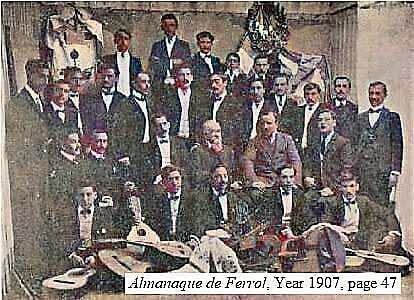
A few foolhardy, vibrant, enthusiastic young men began it all when they decided to get together to sing in a "very modest" locale, furnished only with a few benches of pine, which they had crafted themselves, and a straw-cushion chair reserved for their conductor, Seoane Pampín (second row, centre).
In October 1906 this motley crew earned first prize at a national competition of serenaders held in Lugo City. Theirs was a "colossal triumph" because their direct rival was none other than a professorial chorale nicknamed, "The Invincible."
This quotation comes from Victoriano Suanzes' review,
One ought not to forget that in whatever artistic jousts Airiños engaged, Madrid, La Coruña, Pontevedra, Gijón, León and Lugo, it always won the first prize and vaunted laurels to boot: diplomas signed by very famous maestros, opulent plates donated as presents by the Ferrolians living in Buenos Aires, splendid neckties testifying to their success in Gijón and Lugo...and crowns and flags, one of them a genuine jewel gifted by Vigo's Ferrolian colony.For Airiños d'a miña terra counts its exhibitions for victories and, taking the name of Ferrol to all sister regions, has earned the inestimable honour of exalting it in the golden temple of Euterpe.
(Almanaque de Ferrol, Year 1907, page 48)
Despite a "very strong" gale and rainstorm that struck Ferrol Saturday night and lingered through Monday, New England's benefit show on Sunday drew an "extraordinary" number of people to all three sessions, particularly to the more expensive one at 9:30 PM.
"The Spinsters," the one-act play enacted by the Thalía society, was applauded endlessly and the play's interpreters compelled to take repeated curtain calls.The large audience tributed equally vehement ovations to the laureated band of serenaders, Airiños, which executed in marvellous fashion, as it does always, the more prominent numbers of its broad repertoire.
The gate for the three sessions totals 699 Pesetas with twenty-five cents.
(El Correo Gallego. November 19, 1906, page 2)
In late November the New England pavilion scrambled to contract a Chronophone for a few days before its unidentified owner went off to other gigs in Spain and Portugal (ECG. November 26, 1906, page 2).
The newspaper asserts that "this is Spain's sole talking cinematograph" and that Ferrol will be one of the first Spanish cities where "this astounding invention is shown." Note: This webpage documents the early history of the Chronophone in Spain; the French invention was operated publicly in Spain for the first time in Teatro Circo of Vitoria (Basque Country) on April 5, 1905 (End of Note).
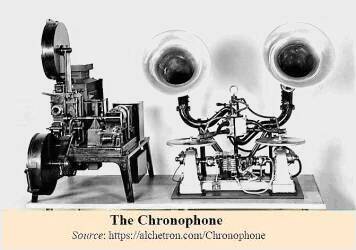
The Chronophone (photograph on the right) was invented by Léon Gaumont in 1902. The Chronophone brought sound indirectly to silent films for the first time by synchronizing the speed of two independent devices: the silent film projector and an auxiliary record player (gramophone). The Chronophone's control panel switched the two independent devices on simultaneously and ensured that the projector's speed in f.p.s. (frames per second) equalled the gramophone's r.p.m. (revolutions per minute).
The arcane trademark, "chronophone," may then have been Gaumont's contraction of the phrase, "chronometered gramophone," it being understood that the primary chronometer or "dominant time-keeper" in the set-up is the movie projector's f.p.s.
The presence of two gramophones in the photograph suggests that one played recorded voice and the other played music.
The Chronophone's first showing in the New England theater on Wednesday November 28 was a tremendous success. The customers left "highly gratified with the cinematograph that undoubtedly surpasses the former one to an extraordinary degree; the images are much cleaner, the reel flits less and the presentation is well-groomed" (ECG. November 29, 1906, page 2).
A phonoscène ("scene with sound") sample, shot by the Gaumont Film Company presumably in 1906.
El Correo Gallego of Saturday December 8 informed that Brindis de Salas (b. 1852, d. 1911) had arrived the day before from A Coruña to give two concerts at the New England pavilion on Monday.
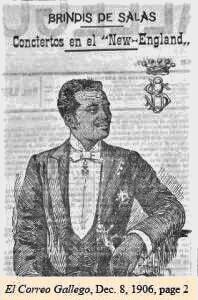
Brindis de Salas "was born in the Pearl of the Antilles [Cuba] where so many of our expats reside...He is tall, handsome, tan skin and exceedingly pleasant conversation and bearing...he did his studies with the endowment of the Spanish government."
The article describes him as a first-rate violinist invariably acclaimed by his audiences. The piece transcribes some accolades the artist received from the press of A Coruña after his concert,
All the items of the program were executed marvelously by the eminent violinist. His admirable artistic personality manifested itself vigorously as he seemed to be indulging himself improvising difficult twists and turns throughout the various intricate compositions, enacting a wonderful boast of his mastery of the violin...The ovations of the audience lasted a long while...This particular skill of the Cuban violinist is really magnificent and perhaps unique: he plucks out of the chords of his instrument the bass notes of a violoncello, the delicate arpeggios of a harp or the clear sharps of a flute simultaneously. The illusion he crafts is perfect; anyone would avow that a harmonized orchestra is playing with one accord.
(El Correo Gallego. December 8, 1906, page 2)
Brindis de Salas confirmed the reputation that preceded him, and he may well own the legitimate presumption of being one of the world's foremost violinists today...The applause and ovations that the savvy ones regaled him with attested to his great worth.(Revista Gallega, December 9, 1906, page 4)
Note: Brindis de Salas was also an occasional composer (End of Note).
At the New England pavilion Brindis de Salas intervened in the second half of Monday's 6:00 PM session accompanied by a certain Mr. Brañas at the piano. Ticket prices were twice the usual rate for a padded seat with armrest and a bench seat. General admission cost 0.30 Pesetas.
The Cuban violinist played three pieces,
The 9:00 PM concert portion covered the six numbers listed below. The ticket prices were 1.50 Pesetas for a padded seat with armrest, 1 Peseta for sitting on a bench, 0.40 Pesetas for general admission.
"This most notable violinist" performed "brilliantly" in front of a "distinguished and most numerous" audience. After each concert he was called repeatedly to the stage by an auditorium that applauded him enthusiastically (ECG. December 11, 1906, page 2).
Brindis de Salas left Ferrol on the 12th (ECG. December 12, 1906, page 2) for Lugo City.
On his parting day Brindis de Salas "entreated" the editors of El Correo Gallego to published this singular letter,
Mr. Director of EL CORREO GALLEGO,[Archaic greeting of the epoch]
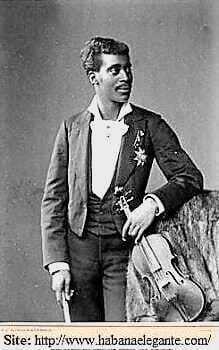
I do not wish to part from this beautiful town, from which I take away the most delightful and indelible memories, without making public, by way of the Press, my heartfelt acknowledgement for the multiple and undeserved attentions I was made the object of by the sons of this noble and chivalrous city.
Even though I leave, the name of Ferrol and its citizens will always go with me as a settled proof of affection.
And I wish to make this my gratitude extensive to Mr. Eduardo Brañas the piano player who, with his vast knowledge of music, made my work on the violin easier, work so undeservedly sanctioned by the public with rapturous applause and, where the Press of this comely city is concerned, with eulogies I am far from deserving.
A thousand thank-you's, distinguished Director, for inserting these lines, and...
[Archaic ending of the epoch]
Brindis de Salas.
Ferrol, December 12, 1906.
(El Correo Gallego. December 12, 1906, pages 1-2)
Full houses, rave reviews, concertgoers' unbridled enthusiasm defined his first Galician tour, which ended in March 1907.
He returned for a second triumphant tour in August 1907.
Brindis de Salas died four years later in Buenos Aires in dire poverty.
Upon the news a Galician newspaper commented with bitter irony,
You no doubt remember Brindis de Salas, that magnificent black man, great violin player, who gave several concerts in Galicia. Brindis de Salas exerted himself wearing the colour of his skin. If Brindis de Salas had been a pale-faced towhead he would have enjoyed a better fate unquestionably.But it was not to be. The excellent musician has died destitute and forgotten.
He travelled the whole world over. He gathered together a few newspaper clippings and the memory of many ovations, and with that meagre bounty, sick, indigent, he left Spain for Buenos Aires...
His life flickered out miserably in a guest house of Paseo de Julio [today's Avenida Leandro N. Alem].
Then the people and the newspapers snatched his corpse and dedicated eulogies and speeches and articles. And they interred him solemnly.
Thus vanished the black Bohemian who with his art was able to make his name known the whole world over.
(El Regional: Diario de Lugo, July 3, 1911, page 2)