The customary yearly review of Almanaque de Ferrol dedicates the following paragraphs to the New England of 1907,
The expert actions of an intelligent Company have successfully melded the schooling of theater with the constraints of our ordinary means in the construction of the "New-England" pavilion, about which I find no serious qualm other than its name, exotic and inadequate.The tedious hours of our wintry afternoons and evenings glide by pleasantly in the spacious salon that brings Ferrolian society together to savour the charms of an almost intimate rendezvous spruced with the most attractive pastimes of the spirit.
I believe to have said on other occasions that theatrical seasons like last March's are almost indispensable in our times averse to reading or to hearing hard-to-stomach stern lessons of morality. They should be served to the public embellished with the allure of film projections, as the Ateneo's modern talks do.
I realize that many on reading this page will recall the bawdy offerings of our contemporary theater; but I maintain that these depend, for the most part, on the tastes of the audience. Companies protect their interests first and so they select treats carefully in keeping with the diners' palate.
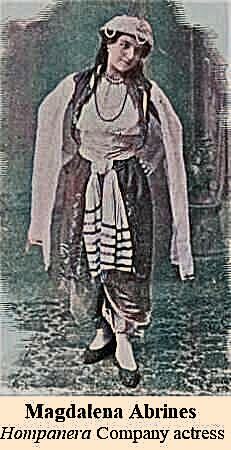
And leaving aside extreme views of White intransigence, perhaps as ridiculous and dangerous as those of Red intransigence, there are works so wholesome and unblemished in our theatrical repertoire—as Hompanera's company has demonstrated—that it's even a cultural duty to assist in making them as popular as possible because, delighting the spirit and riveting the attention, they preach with fictitious effects of living reality and inscribe lessons alien to home and classroom since both can not experiment like the stage does.
Iglesia [Church] Street's small theater, which compares very well with those of other cities more important than ours, fulfills this teaching mission, a tough endeavour here because Teatro Jofre is a very expensive University, though its academic offerings do not circumscribe exclusively to the eminences whom we would like to see and applaud more frequently than we do today.
(Victorino Suanzes. Almanaque de Ferrol, Year 1908, pages 23-25)
On Saturday February 16 Hompanera's company made its debut at the New England. By this time the pavilion had sold sixty-one family season tickets (ECG. February 16, 1907, pages 1-2).
That day the acting company performed Echegaray's play, De Mala Raza, ("From Bad Stock") at 6:00 PM, and Guimerà's classic drama, Terra Baixa, ("Lowland") at 9:00 PM. This second play, written in the Catalan language, was almost immediately translated to Spanish and later to German ("Tiefland") English ("Marta of the Lowlands") and Italian ("Terra Bassa").
Terra Baixa (1982)
The debut of Hompanera Company garnered an "excellent" response and represented a "great triumph" (ECG. February 18, 1907, page 2). More customers rushed to buy season tickets.
The troupe produced many plays and sketches over the rest of February and during the month of March.
Special mention could be made of the comedy skit written by Abati and Reparaz in 1902, Los Hijos Artificiales (The Phony Sons).
"The audience did not cease laughing for a single moment...the customers left very pleased with the spectacle and applauded all the actors warmly." Many people who did not see the show begged the reporter to ask the New England pavilion to "repeat that very funny show tomorrow afternoon" (ECG. February 28, 1907, page 2); and indeed it was reprised then and on March 11 to an equal reception.
Los Hijos Artificiales (1943)
The first show of Los Hijos Artificiales on Tuesday March 5 lasted longer than scheduled and delayed the start of the 9:00 PM theatrical session for about an hour, a happenstance that prompted the night audience to manifest its displeasure openly (ECG. February 28, 1907, page 2). Hompanera promised the reporter that strict punctuality would be observed thenceforth.
This was the second lapse in the strict punctuality that had distinguished Hompanera from the start and which it had demanded of its audience (ECG. February 21, 1907, page 2). The first lapse had occurred on Saturday February 23 when the troupe opened the 6:00 PM session half an hour behind schedule and finished too late to dine out (ECG. February 25, 1907, page 1).
On Wednesday March 13 the troupe staged Bremón's new drama, El Poder De La Razón, (The Power of Reason).
The play, set for 9:00 PM, apparently versed on "the resolution of the socialist problem via concordance between capital and labour" (ECG. March 13, 1907, page 2). Mr. Bremón himself was present at the New England as were José Borrás Vizoso the chief police inspector and Vicente Fernández Lopez the mayor.
A "numerous group" of armchair customers showed its displeasure by refusing to clap after the final act. One shouted, "No! No!" when another section of the auditorium called on Mr. Bremón to go up on the stage and take a bow. At this point the chief police inspector turned on the nonconformists using "abusive terms" and a ruckus followed. The incident might have had "serious consequences" but for the "very opportune" intervention of the mayor who sided with the nonconformists and defended their right to express their disapproval (ECG. March 14, 1907, page 2).
The affair did not end there. The next day a committee of offended patrons asked Town Hall to inform the provincial governor of their complaint against the police inspector. The mayor complied immediately and the Corunnese governor requested the police inspector to present his defence in A Coruña (ECG. March 18, 1907, pages 1-2). Doubtlessly the governor referred the case to his superiors because on the night of Monday March 18 the State's governance minister telegraphed his final verdict; Mr. López resigned as mayor on Wednesday March 20 and Mr. Vizoso became Ferrol's new mayor on the 21st (ECG. March 20, 1907, page 2).
Owing to "the reiterated pleas of a large segment of the public" Hompanera Company postponed its departure and staged an intended eight additional sessions to start Tuesday April 2, after Holy Week. "Since daylight lasts longer now the sessions will commence at 8:30 PM sharp to enable Fleet personnel to return aboard without a hassle" (ECG. March 26, 1907, page 2). The number of sessions was in the end reduced to six (ECG. April 2, 1907, page 2).
On Sunday April 7 an extra eighty chairs had to be brought in to accommodate the number of customers who showed up for the company's second last day.
The last performance took place on Monday April 8. Curiously El Correo Gallego did not report on it.
On the afternoon of Friday April 12 the New England received from Paris the Gaumont-D cinematograph it had purchased (ECG. April 13, 1907, page 2). The film projector would not be ready to operate until two weeks later.
Meantime the pavilion put on a provisional spectacle on the weekend of Saturday April 20. In the first of two acts a "daredevil and notable skater Mr. Tumilet" executed three routines named "The stairs of death," "Mazelike equilibria" and "Sensational race" and in the second act a folk group, Trío Aragonés, interpreted Aragonese dances.
This entertainment program was repeated on Sunday and the artists departed on Monday.
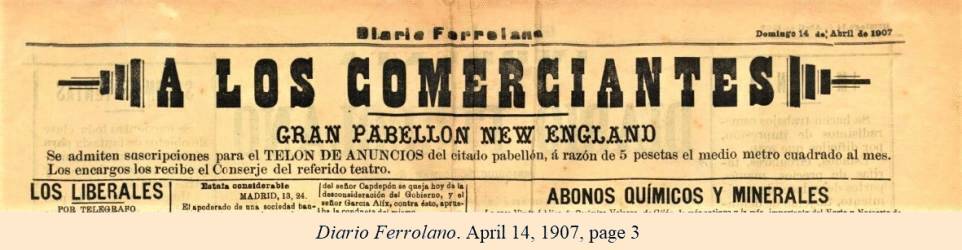
During April 1907, the New England inserted the above advertisement on page 3 of the two Ferrolian newspapers, El Correo Gallego and Diario Ferrolano. The ad invited retailers to purchase publicity space on the pavilion's fire curtain. The cost was 5 Pesetas per ½ square meter per month.
The New England reopened on Friday April 26 with two shows, 7:30 and 9:00 PM. The 9:00 PM shift appended a one-act stage comedy with actor and actress.
The same movies were shown at 7:30 and 9:00 PM. Their titles were:
"All the films shown, some feature-length, were applauded heavily and fêted by the public" (ECG. April 27, 1907, page 2).
Some silent films shown between April 27 and May 4 linger in cyberspace,
On May 10 the theaters New England and Jofre subscribed a contract to share the cost of hosting Montijano's company in a new theatrical season of ten shows scheduled to begin Thursday May 16. The peculiar arrangement was possible because the same Vicente Auboín Barcón who solicited the permit to build the New England subsequently entered and won the municipal contest to rent Teatro Jofre from December 15, 1906, to November 30, 1907 (ECG. December 17, 1906, page 2). Note: The following year he lost the municipal contest for the period December 5, 1907, to November 1, 1908 (End of Note).
The arrangement established a floor of presold season tickets whose individual cost was 14 Pesetas for a padded seat with armrest and 7.50 Pesetas for a seat on the first row of benches. The expense proved too high for most New England patrons, the target floor was not met and on May 16 the pavilion announced its rescission of the contract.
Montijano's company did in the end debut at the New England on Saturday October 5. The company staged the Spanish version of Gavault's and Charvay's play, Mademoiselle Josette, ma femme to a full house. This French comedy was adapted to the screen several times; here is the title song of one,
Mademoiselle Josette, ma femme (1933)
On Sunday October 6 the afternoon session and a new show registered another full house at the New England. The troupe moved across the street to Teatro Jofre for the night session and there too it performed in front of a full enthusiastic house (ECG. October 7, 1907, page 2).
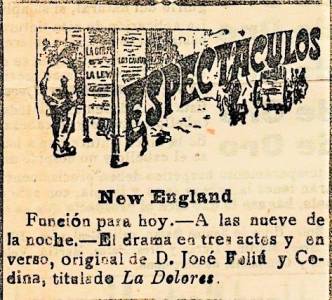
This novel arrangement between New England and Jofre did not require an issue of season tickets. The individual tickets for an afternoon session at the New England cost 1 Peseta for a padded seat with armrest, 0.60 Pesetas for a bench seat and 0.30 Pesetas for general admission. Tickets for a night session were roughly 60% higher. Customers were offered the option of reserving all the night sessions at discount prices.
Montijano's company did the majority of its performances at the New England. Public acclaim followed public acclaim, and tickets for the padded seats with armrest and for bench seats were often sold out. El Correo Gallego of October 22 even returned mention of the New England to its front page and assigned a full column to the summary of a play scheduled for that night. The night was yet another "brilliant success" (ECG. October 23, 1907, page 2).
Surprisingly the only reported misbehaviour occurred at the posh theater across the street, Teatro Jofre. There on Sunday October 20 "the spectators in the stalls complained with reason about the municipal police's failure to curtail vigorously the tease of some spectators in the balconies who flung cigarette stubs, papers and even scraps of churros to the deck below" (ECG. October 21, 1907, page 2).
The "scandal" hatched a second time on November 1 with the representation of Zorrilla's classic, Don Juan Tenorio. The newspaper criticized harshly the failure of Vizoso the mayor to end the continual annoyance that "a great proportion of the spectators must endure." Items hurled from the balconies to the stalls included "chestnuts, churros, cigarette stubs, eggs and various liquids" (ECG. November 2, 1907, page 2).
On Sunday November 10 a "phenomenal scandal" during the representations in Teatro Jofre triggered a premature curtain fall. The mayor's presence at the venue did not deter the rascals. "The public lamented over these incidents and considers that if things continue as they are it will have to renounce going to the theater" (ECG. November 11, 1907, page 2).
At the New England on Thursday October 24 Montijano's troupe staged the 1904 comedy, Jettatore!, of Argentinian playwright Gregorio de Laferrère.
Jettatore! (1938)
A "distinguished public" went to watch the debut of the Argentinian comedy. "The play's multiple comic situations and the wholesome and refined humour of its clever dialogue were celebrated uproariously" (ECG. October 25, 1907, page 2).
Montijano's company bid farewell to Ferrol on Sunday November 10 with two shows in the New England at 3:30 and 5:30 PM, and a night show in Teatro Jofre across the street. A "numerous public" bid the troupe farewell, especially at 5:30 PM.
The pavilion next switched to Vivancos' zarzuela company.
"This season in the pretty little theater promises to be dazzingly brilliant. The most select of our good society will assemble for the 6:00 PM vermouth sessions. We understand that Piña [a social club of Ferrol's establishment] has reserved more than a hundred padded seats with armrest" (ECG. November 14, 1907, page 2). The season began on the night of Saturday November 23.
The year ended as it had started, with accolades for the New England. "The public keeps favouring the small theater on Iglesia ["Church"] Street" (ECG. December 10, 1907, page 2). "The number of patrons was not as big as in previous days due to the unsettled weather" (ECG. December 12, 1907, page 2). "Good business day yesterday for the favoured little theater of Iglesia Street; every session drew a full house."
On Sunday December 15 the box office for the 4:00 PM representation of Los Sobrinos del Capitán Grant ("Captain Grant's nephews") sold out, leaving about three hundred disappointed customers outside (ECG. December 16, 1907, page 2). The comedy-drama was reprised "with extraordinary success" at 5:45 PM on Monday December 16.
Los Sobrinos del Capitán Grant (1973)
Vivancos' troupe closed a "brilliant season" on Tuesday December 17, "the afternoon and evening shows were magnificent hits...the public bid an affectionate farewell to the company" (ECG. December 18, 1907, page 2).
New England spent the last week of 1907 offering movies and live dances.
The "grandiose" short film of 1906, Los perros contrabandistas (The Smuggling Dogs"), "excited much interest."
The dancers were a "renowned" Russian family named "Chérenieteff" and a trio named Charlús.
"All sessions drew large crowds to the pavilion" (ECG. December 31, 1907, page 2).