The New England bounded with Iglesia ["Church"] Street to the north, the municipal jail to the east, the downtown gardens to the south and a short street then named Paseo de Suanzes to the west. Teatro Jofre stood on the opposite sidewalk of Paseo de Suanzes.
The customary yearly review of Almanaque de Ferrol dedicates the following paragraph to the New England of the year 1908,
The fortunate little theater New England next to Alameda de Suanzes continued [in the year 1908] as it continues [at the date of the writing, November 25, 1908] opening its doors daily to a throng of customers, favoured with widespread acceptance justly deserved for its adaptation, within the reach of the average wallet, to local partialities and tastes and for its accommodation to the feasible leisure hours of all social classes.(Anonymous. Almanaque de Ferrol, Year 1909, page 46)
The month of January brought marquises, generals, Piña [the social club of Ferrol's establishment] and distinguished members of society to the padded seats with armrest of the New England.
The comic-dramatic company of Mr. Rodrigo entertained the auditorium during the whole month of January and the first half of February. The newspaper used the phrase, "select and numerous audience," many times.
On Sunday January 26 the size of the crowd inside the pavilion reached "epic" proportions (ECG. January 27, 1908, page 2).
On Thursday January 30 the 1892 British farce, Charley's Aunt, filled the auditorium with constant laughter, as did every comedy that Rodrigo's company acted out,
Charley's Aunt (1941)
Rodrigo's comic-dramatic company wrapped up its gig on Thursday February 13.
"The magnificent theatrical season in the New England closed in splendid fashion...Yesterday the afternoon and evening patrons bid an affectionate farewell to the hard-working and delightful artists" (ECG. February 14, 1908, page 2).
The article also congratulated the New England for "its precision and diligence in satisfying the public's wishes."
On Thursday March 12 the pavilion collated movie shows with live performances of a magician, Doctor Posadas, and of acrobats named the Koker brothers.
Regarding the movies, the New England patrons found these particularly enthralling,
Regarding Doctor Posadas, his "Carrier Pigeon" trick was highly admired. The day's two sessions, 6:00 and 9:15 PM, registered a full house (ECG. March 13, 1908, page 3).
Doctor Posadas and the Koker brothers wound up their contract on Wednesday March 25; the three sessions, 4:00, 6:00 and 9:15 PM, were sold out. "The notable doctor Posadas was greatly applauded during his routine" (ECG. March 26, 1908, page 2).
On April 5 the last movie shown at the pavilion ahead of Holy Week was The Passion and Death of Christ, a feature film of 1903.
"Yesterday all cinematograph sessions logged a full house" (ECG. April 6, 1908, page 2).
The New England closed its doors and did not reopen until Saturday April 18 with more movie shows and cheaper! tickets.
On Thursday May 7 the New England collated movie shows with live routines once more.
The first routine was an electric doll operated by "Zoraida the delightful Muslim woman"; the second routine belonged to a quick-change artist named Rafael Arcos.
On Friday May 8 Rafael Arcos presented a sketch named "Moulin Rouge" in which he disguised himself as a female tobacconist and as a magician.
Next he assumed multiple personalities in three skits, "La Jolie comedie"/"Un tenore leggero"/"Señora de Rodríguez" (Mrs. Rodriguez).
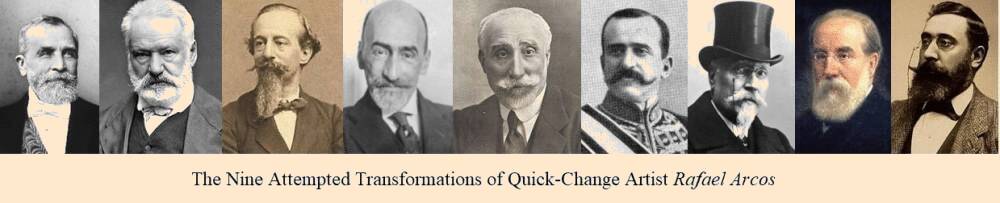
Finally he impersonated nine celebrities consecutively: Loubet, Victor Hugo, Zorrilla, Benavente, Maura, Romanones, Echegaray, Pí Margall and Curros Enríquez (ordered from left to right below).
|
|
The newspaper praised Rafael Arcos every day.
"A notable quick-change artist" (ECG. May 12, 1908, page 2); "he had to improvise an extra routine owing to the loud rounds of applause he received"; "he is an excellent artist" (May 14) "most notable" (May 16) "celebrated" (May 18) "skilled"; "did a very meritorious job"; "the Company gifted him a gold watch" (May 19).
His last day was Monday May 18. He departed for Havana under contract.
The comic-dramatic company Tressols came next and performed Sunday May 31 through Sunday June 7.
The newspaper employed the hackneyed phrases, "numerous public...select audience...heavy applause," to describe the customers' reaction to this troupe's production, yet one can infer that a little less enthusiasm surrounded Tressols' stopover because, although it introduced lavish attire and plush backdrops in its representations, part of its repertoire had already been essayed by the preceding companies, Hompanera, Montijano, Vivancos and Rodrigo.
After Tressols' departure the New England shut down for a protracted break.
The New England reopened on Monday August 17 with three identical sessions, 7:00, 9:30 and 10:30 PM. As usual the blend of the cinematograph and varieté portions constituted a session.
It is nearly always a challenge to pry from a disjoint Spanish title the genuine cinematograph.
An attempt was made to identify the seven films of August 17, but the effort yielded a mere two candidates,
"The charming theater's inauguration of a new season was a success."
On Saturday August 22 Mlle. Liliane debuted before packed sessions.
Indeed a full house was the norm during her entire gig.
On Saturday September 12 the pavilion honoured the officers and crew of a visiting Italian cruiser named Etna with a 7:00 PM gala session. A musical sextet, the projection of seven films and the debut of Celestino Augusto "renowned bird-call imitator" comprised the tripartite show. All the tickets were sold out (ECG. September 14, 1908, page 2).
On Tuesday September 15 the New England shut down for repair work until Saturday October 3 when Montijano's company returned for a second year.
Montijano's troupe performed from October 3 to Sunday November 8 and reaped another triumphal season like that of 1907.
"The season of forty shows that the company of Mr. Montijano has delivered at this theater has been exceedingly brilliant in every sense. The performances tallied full houses. Yesterday the company's farewell session of the afternoon logged an impressive full house and in the night session many people failed to get inside as all available tickets had been sold" (ECG. November 9, 1908, page 2).
It is fair to say that at this juncture the New England had eclipsed every other competitor in the city, including Teatro Jofre, in terms of attendance and popularity.
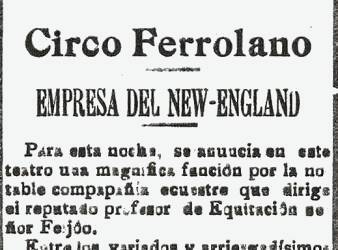
The cash flow was so good that the pavilion rented the arena of a competitor, Circo Ferrolano, to present the "international" and multi-faceted circus of Secundino Feijóo.
The Feijóo Circus brought horses, acrobats, gymnasts, dancers, runners, a "Dragon Man," the "Troupe Impérial Chinoise," an "aerial pedestrian," buffoons and Cheret the "popular fool." The circus made its debut on November 11, all tickets sold.
"The company is without exaggeration among the best that have ever performed in Ferrol" (ECG. November 12, 1908, page 2).
The three weekend shows of November 14-15 enjoyed a massive affluence of customers. Many people were unable to get in and some left outside protested, but the New England stuck to the policy of not letting more people in than the maximum number allowed, and this to avert inconveniencing the customers who had already been admitted.
The weekend functions of November 21-22 reaped "three colossal full houses."
Mr. Feijóo's notable company is liked more and more each day, and the artists garner constant clapping for the extremely difficult and risky exploits. The Aragón brothers, the great Leopoldo, Mlle. Juliette's balancing act, the celebrated fool Cheret, have earned the favour of the crowd, which applauds them without pause.
[...]
Several gentlemen entreat us to have the company install a safety net for the routine of the great Leopoldo in order to obviate a fatal mishap.
(El Correo Gallego. November 23, 1908, page 2)
The weekend functions of November 28-29 saw a slight drop in the volume of customers.
Apparently the final day of Feijóo Circus was Tuesday December 1.
The New England dedicated part of the revenue it earned at Circo Ferrolano to a notable reduction of ticket prices at the pavilion. The three cinematograph sessions of Saturday December 19 posted these rates: 0.40 Pesetas for a padded seat with armrest, 0.25 Pesetas for sitting on a bench, 0.15 Pesetas for general admission (ECG. December 19, 1908, page 2).