The disastrous blow to the Spanish Navy in 1898 during the Spanish-American War forced Spain to choose between renouncing its dream of being a naval power or pursuing it by building a large modern fleet on an initial budget of 180 million Pesetas.
On January 7, 1908, the Spanish government published the Law of the Fleet. The law spawned the official government solicitation of April 21, 1908, requesting bids by private Spanish or foreign enterprises to "rent" under certain obligations the arsenals of Cartagena and Ferrol for building the new fleet.
The original obligations for the case of Ferrol were (a) to build three cruisers of 15,000 tons displacement each, fully armed, (b) to construct one new stocks for large ships and provide cranes, (c) to construct a wharf with railway access, (d) to build a blacksmith workshop equipped with the latest tools, (e) to fulfill several other demands including the construction of a dry dock for large vessels and the completion of a power station.
On August 21, 1908, the solicitation process terminated at 3:00 PM and the received bids were made public, every one sponsored by Spanish "shareholders."
The first bidder was a French consortium headed by the firm, Forges et Chantiers.
The second bidder was the Italian firm, Ansaldo.
The third was an Asturian venture in association with William Beardmore & Co.
The last bidder was the British conglomerate Vickers-Armstrong composed of the companies Sir W. G. Armstrong Whitworth & Co. Ltd., Vickers Sons & Maxim Ltd. and John Brown & Co. Ltd. (ECG. Sunday March 21, 1909, page 4, special issue).
The Spanish sponsor of this fourth bid was Sociedad Española de Construcción Naval (Ferrolians later nicknamed it, "La Constructora"). This shareholders society had been constituted on August 18, 1908, and enlisted five metallugy manufacturing firms, two shipping companies, nine banks and a credit union.
On February 5, 1909, the Official Bulletin of the Ministry for the Navy published a circular notifying the provisional adjudication of the government contract to the Vickers-Armstrong conglomerate.
The provisional adjudication of the government contract to Vickers-Armstrong on February 5, 1909, ended the longstanding uncertainty surrounding the contest for building the new Spanish fleet.
At this time Albert Vickers (photograph below, left) was the chairman of Vickers Sons & Maxim Ltd. and John M. Falkner (photograph below, right) was the chairman of Sir W. G. Armstrong Whitworth & Co. Ltd.
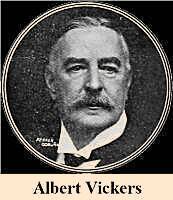
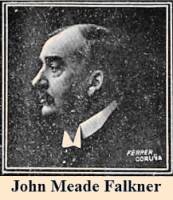
Both photographs come from page 7 of the bulletin, Acorazado España, printed by El Correo Gallego to mark the launch on February 5, 1912, of the first cruiser following the British takeover of the technical and administrative operation of the Arsenal.
The comparatively minor component of the British triad, John Brown & Co. Ltd., had two directors, Charles E. Ellis and John Sampson. "John Brown & Co. Ltd. will build a turbines workshop with a price tag of one million Pesetas," the newspaper said.
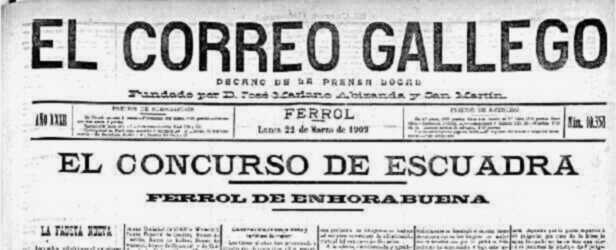
On Saturday March 20, 1909, the joyous news of the definitive adjudication of the contract to Vickers-Armstrong arrived to Ferrol via urgent telegraph sent that day from Madrid at 9:15 AM and received in the offices of El Correo Gallego at 10:30 AM.
The March 22 number of El Correo Gallego, whose front-page's mast-head, headline and subtitle are reproduced beneath, informed that Mr. A. J. Campbell the Head of the Works Department at the Vickers Barrow-in-Furness yard would assume a similar post in Ferrol and that Mr. Peter Muir would be his Assistant Head. Many other British professionals from across the industry had signed seven-year contracts and would take charge of the various workshops in Ferrol.
|
|
The paper relates that when news of the definitive adjudication of the contract arrived to Ferrol,
All faces reflected a vibrant profound intense inner satisfaction, legitimate expression of the pleasure roused in all souls by a return to work after a protracted period of hardships and misery with disastrous consequences alas! for many homes.Retailers, industrialists, landlords, workers: all the elements that give life to our people expressed full of ardent enthusiasm the immense joy they felt on hearing the news of immediate prosperity.
Proper are these popular displays and moreover amply justified in a people who, like ours, was born underneath the shade of our splendid and envied naval factory on which they depend to stay alive.
(El Correo Gallego. March 22, 1909, page 2)
Mr. A. J. Campbell's literal job title was "Director of Naval Construction under the Commission responsible for the building of the new Spanish fleet" (The Shipbuilder, Vol. 4, Years 1909-1910, page 18, ed. A. G. Hood).
The same volume asserts on page 41 that "Mr. Campbell has considerable experience in Spain and speaks the language fluently. It is understood that he will have as his assistant Mr. Peter Muir, who has just returned from Russia."
The start of the year 1909 saw feverish activity in Teatro Jofre, the posh theater of Ferrol's elite. The elitist theater adopted the entertaiment format of the pavilion it faced across the street. The melding of varietés and cinematograph sessions was a resounding success.
On New Year's Day, 1909, the New England too had "grand" sold-out shows.
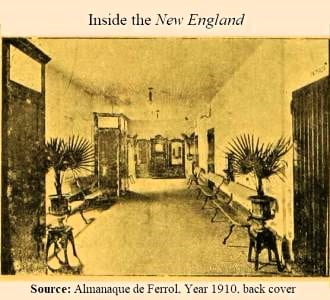
There were six sessions in the pavilion that day, 3:00, 4:00, 5:00, 6:00, 9:00 and 10:00 PM.
Afternoon tickets remained inexpensive, 0.40 Pesetas for a padded seat with armrest, 0.25 Pesetas for sitting on a bench, 0.15 Pesetas for general admission. Evening tickets were dearer, 0.50 Pesetas for a padded seat with armrest, 0.30 Pesetas for sitting on a bench, 0.20 Pesetas for general admission.
However it was obvious that in an "entertainment war of attrition" Teatro Jofre owned a bulky wallet and would eventually outdo the pavilion. For one, all the seats in the posh theater were padded, "very comfortable," said the newspaper, whereas the benches of the New England were hard benches indeed (photograph on the right).
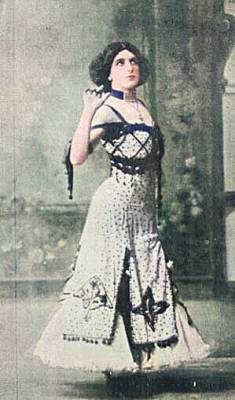
On Saturday January 9 the newspaper reported that more and more people were going to the New England to watch the live performance of travesti Ernesto Foliers (photograph to the left).
Foliers mimicked the famous female celebrities of the day, their gestures, walk and voice "marvelously". "Whoever sees him perform falls under the illusion that a woman is really on the stage" (ECG. January 9, 1909, page 2).
On Sunday January 10 the afternoon sessions were sold out and a "numerous public" watched the evening shows.
Foliers garnered thunderous applause and the audience requested him to repeat several numbers.
Monday was Foliers' final day. He danced to Machicha's beat.
Two months after its first triumphal visit Feijóo's circus returned on Tuesday January 12 to Circo Ferrolano for a brief 3-day engagement under the aegis of New England.
The three days registered full houses, and to compliment the great affluence of customers in spite of the foul weather, Feijóo and New England decided to add a special function at 9:00 PM on Friday January 15 featuring Sadakazu Uyenishi alias Raku, a Japanese jiu-jitsu master who was offering a reward of 500 Pesetas to whoever could beat him in a fight.
Friday's special function was an "enormous colossal hit,"
Distinguished families filled the loges and the deck's padded seats. General admission brimmed with people eager to see whether everything that had been said about Raku was indeed true. Their expectations did not founder because this small thin man is unquestionably an athlete with the nimbleness of a tiger.[...]
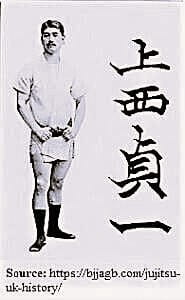
The appearance of Raku, awaited by the public with genuine emotion, was the thrill of the night. A salvo of thunderous prolonged applause greeted his appearance on the canvas.
The renowned jiu-jitsu champion is young, thin, of average height and pleasant demeanour. All his moves reveal great agility and skill.
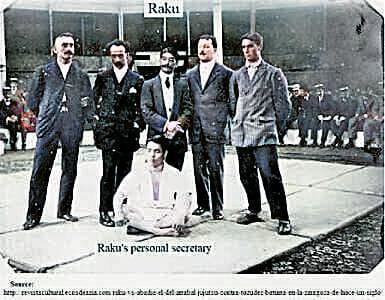
His personal secretary, a robust and stout Japanese man, initiated the skirmishes. From the start the immense crowd that filled the entire Circo focussed its attention intently on the dexterous fighter.
Raku's agility, skill, talent, swiftness and precision during his warm-up routine were admirable...Raku's secretary used dagger, stick, cudgel and various other weapons in his lunges at Raku...
[...]
Following Raku's scuffles with his secretary there entered the arena a young man surnamed Rodríguez who notified beforehand his waiver of the 500-Pesetas reward being offered by Raku. Rodríguez hailed from Marmancón and had the local reputation of being a strong lad.
From the duel's first moments the supreme ease with which Raku overpowered and defeated his adversary became evident, playing with him—let the simile stand—as a cat toys with a small mouse. The duel lasted three minutes and a few seconds, then the hardy young man banged the floor three times as a sign of surrender.
[...]
Toward the end of his act Raku invited the six strongest men in the audience to come and press down hard on the two ends of a long rod beneath whose middle he would lie, neck pressed against the wood.
Raku lay down and withstood that formidable pressure nonchalantly. Then with swift moves of incomparable suppleness and prowess the famous champion disencumbered himself of that strip of wood which seemed to have left him lifeless on the canvas.
The majority of spectators rose to their feet and cheered the famed champion.
Without any doubt the public left Circo last night highly gratified, praising the Japanese fighter unreservedly...
This afternoon two sturdy young men from La Coruña will arrive on one of the steamships; they are notorious in the nearby city for their strength and they come solely with the aim of grappling with Raku. One is nicknamed "Tan" and the other, whose name is Manuel Brandariz, has grappled with Raku several times.
The contest will be extremely interesting and packed with emotion.
Tonight's show will commence at 9:00 PM sharp.
[...]
We congratulate the New England Company and are certain of another colossal full house like last night's.
(El Correo Gallego. January 16, 1909, page 2)
The British troupe, The Canadians, who had been expected to debut at the New England on August 17, 1908, finally showed up...on Saturday January 23, 1909, at Teatro Jofre across the street!
Monday's newspaper dedicated considerable space to praise the female British troupe to the skies, to extol the posh theater's untiring toil to bring so many "varietés" to Ferrol in so short a time and to expound at length on the merits of the next scheduled star.
It is fair to say that at this juncture Teatro Jofre had taken over the lead in terms of attendance and popularity and had every reason to keep it. Nevertheless feisty New England did not throw in the towel.
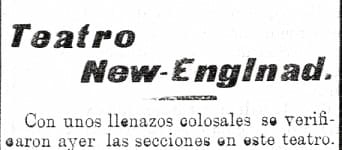
The photograph on the left shows an unpardonable (possibly deliberate) typesetting error made by El Correo Gallego in the header to its regular column on the New England. The misspelling appeared for the first time on Wednesday January 20 and persisted during more than three weeks until Friday February 12!
How could such an oversight go unnoticed for so long? Might this have been an overreach by Teatro Jofre, a disgruntled typesetter's antic or malfeasance induced by some bigwig's ill will?
During the three weeks the pavilion more than held its own, full houses were not unusual. For example, on Sunday February 7 the affluence of customers was "colossal" again and the box office had to hang the sign of no more tickets available (ECG. February 8, 1909, page 2).
The winter season of the small New England theater ended a month later than Teatro Jofre's. On Wednesday March 3 Mr. Balmaña's company closed the theatrical season and bade farewell before a "distinguished and numerous house" (ECG. March 4, 1909, page 2). The company's most popular piece had been the operetta, Alma de Dios, for which patrons of the New England requested six encores.
The theater closed down and did not reopen until Holy Week's Saturday April 10. The newspaper broadly ignored the pavilion from April 10 to May 29.
The pavilion began its second lyrical season on Saturday May 29 at 9:15 PM with the debut of a comic-lyrical company headed by Mr. Aparicio and Mr. González. The "little theater" also hired a recently constituted professorial orchestra, "Orquesta de Ferrol," to provide the musical accompaniment. A month prior the posh theater across the street had blamed this very orchestra's "imprudent" "irrational" fees for the cancellation of its lyrical season, and in a bitter communiqué even presaged the end of all lyrical seasons in the city (ECG. April 19, 1909, page 2). Now everyone saw that New England's management upstaged Teatro Jofre's. Did it attest a better knack for doing business? For inevitably the pavilion was obliged to raise prices substantially, 2 Pesetas for a padded seat with armrest, 0.80 Pesetas for sitting on a bench, 0.45 Pesetas for general admission, and for the first time the municipal entertainment tax was tacked on the customer's wallet.
At this time the newspaper dropped its coverage of functions at the New England drastically. The only reference to the novel lyrical season was June 4 and the report indicates that the pavilion had not blundered,
Yesterday's afternoon and evening sessions at the New England theater were very handsome, and the proficient artists, seconded with acumen by the orchestra, garnered loud rounds of applause.(El Correo Gallego. June 4, 1909, page 2)
The next newspaper reference to shows at the New England tarried until Monday July 5,
This theater will probably reopen its doors the day after tomorrow with varieté and cinematograph sessions...the "Talking Dog," a sensational act, has been booked...the cinematograph reels, brand new, are the latest novelties from Pathé house of Paris.A select sextet will liven up the shows.
(El Correo Gallego. July 5, 1909, page 2)
Presently the newspaper informed every day about the New England for about a week.
"The most distinguished segment of Ferrolian society filled the available seats completely" (ECG. July 8, 1909, page 2).
"The varieté functions continue to be tallied as full houses" (July 9).
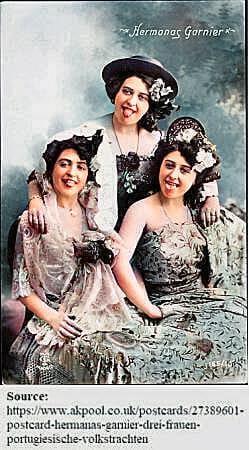
"The gorgeous dancers named Hermanas Garnier (photograph to the right) will debut tonight" (July 12).
"The Company had a great hit yesterday...the numerous audience did not cease applauding the notable artists...the public requested the Garnier Sisters to repeat several of their dances" (July 13).
"The shows at this theater continue drawing big crowds" (July 14).
Then the reporting ceased abruptly. Nevertheless it can be confidently stated that whenever "the charming and favoured New England pavilion" (ADF. Year 1910, page 61) opened its doors it drew a sizeable crowd of customers, sometimes even in foul weather.
Both the New England theater and Teatro Jofre started their winter season late, for the unsettled weather of autumn had arrived early that year when neither theater had yet opened its doors to the public.
Teatro Jofre failed to contract a lyrical company and opened with varietés plus cinematograph sessions on Saturday November 6.
New England booked Rodrigo's comic-dramatic company anew (see Chapter 3) and opened its winter season three weeks later on Saturday November 27.
Tickets for a "simple session" cost 0.60 Pesetas for a padded seat with armrest, 0.35 Pesetas for sitting on a bench and 0.15 Pesetas for a slot in the "stocks" (novel nomenclature!).
The prices for a "double session" were 1.50 Pesetas for a padded seat with armrest, 0.75 Pesetas for sitting on a bench and 0.40 Pesetas for the "stocks."
Customers also had to foot the entertainment tax imposed by Town Hall.
Regarding these higher prices it must be remembered that the British administration of the dockyard (see "British Hustle" next) was improving the lot of many Ferrolian families continually, that the wages of efficient workers were rising steadily and that the naval factory was immersed in a long-drawn hiring spree.
Once more the "elegant theater" upstaged the ritzy one.
On November 27, "big crowd...the management may well be pleased with the triumph achieved...the most disguished members of society filled the section of padded seats in both sessions; the benches and the stocks were sold out...Orquesta de Ferrol livened the intermissions" (ECG. November 29, 1909, pages 1-2).
On Sunday November 28, "if there had been enthusiasm for going to the New England the previous day, yesterday was undescribable...four sessions at 3:30, 4:30, 6:00 and 9:30 PM...for this last one all tickets were gone by early evening and many people could not get in...the company [i.e. Rodrigo's] and the Company [i.e. New England] had a huge success and we forecast a great season for both" (Ibid., page 2).
On November 30 and December 5 Rodrigo's company staged Alexandre Bisson's vaudeville, "La Famille Pont-Biquet" (The Pont-Biquet Family).
La Famille Pont-Biquet (1935)
The final day of Rodrigo's company was Thursday December 16.
On days of "incessant" rain the attendance was modest (December 2) but the weekend sessions of December 4-5 were full houses again. Overall the persistent bad weather (a normal trait of Ferrolian winters) lowered attendance figures considerably.
In the afternoon of Tuesday May 11 Vickers engineers Mr. Campbell, Mr. Ow (sic) and Mr. Spieis (sic) arrived to Ferrol and got their first impression of the dockyard. On Saturday May 15 Mr. Campbell travelled to Madrid and was not expected back until the month of June. Meanwhile Mr. Orr [my guess] was assigned the task of tallying the machines and supplements needed for revamping the Arsenal (ECG. May 17, 1909, page 2).
In the afternoon of Friday June 11 Vickers engineer Mr. Campbell returned to Ferrol accompanied by fellow engineer Mr. Morilorengli (sic). "The British personnel hired to work at this naval factory will arrive next week" (ECG. June 12, 1909, page 2).
On June 15 seven office clerks or managers did so: Mr. R. S. Campbell, Mr. J. Robinson, Mr. W. Mouro, Mr. S. Miller, Mr. J. Gillies, Mr. Gregson and Mr. Matthewson (ECG. June 16, 1909, page 2).
Meanwhile the official handover of the shipyard to British management took place on July 15.
Leading up to the transfer a hundred and seventy men sought employment in the new Arsenals (ECG. July 14, 1909, page 2).
On July 24 a workingmen's union met at the New England theater to move the expulsion of any worker who accepted the payment procedure established by the British. The dispute was tentatively resolved on July 30; workers would get paid on Saturday afternoons.
On August 5 several foundry apprentices were employed.
Meanwhile the salary of every worker kept rising steadily.
Mr. Albert Brooks the British engineer tasked with directing the construction of the new 20,000-tonne dry dock arrived in the city on August 18, as did additional British staff.
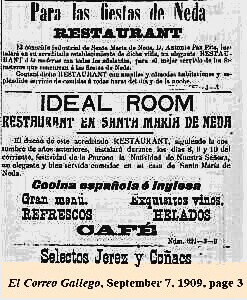
"Twenty-six operators and five apprentices will start working today at the Carpentry Workshop" (August 26).
"An excellent steam-powered crane for hauling materials is functioning as of yesterday near the site of the future dry dock ... Several foundry operators were awarded a pay hike" (August 31).
On September 6 the factory designated sixteen statutory holidays per year. "Special circumstances" could dictate a waiver and make work compulsory on a holiday.
More pay raises for foundry personnel on September 13.
"Thirty-two carpenters and ten apprentices were hired yesterday" (September 15).
"Yesterday several foremen and some forges, machinery, foundry and assembly workshop operators were recompensed with raises" (September 17).
The workers involved in the construction of the 20,000-tonne dry dock went on strike in the afternoon of Monday September 20 to seek the reinstatement of two workers "unjustly" dismissed that morning and to demand a minimum wage of 3 Pesetas/day. The strike ended on October 5. Their demands were fully satisfied.
"Three hundred operators of various trades have been hired since July 15, the date when this Arsenal was transferred to the Sociedad Española de Construcción Naval" (September 28).
A second steam-powered crane had been installed by October 9.
The activity in all the workshops and the very heavy toil involved in the construction of the large dry dock of 20,000 tonnes give the factory the air of a big manufacturing enterprise. Englishmen and Spaniards united share the constant daily labour under the prime direction of their instructors and of the illustrious engineers misters Campbell, Spiers, Rechea [Spaniard], Black, Muir, Brooks and Prehsors (sic).(El Correo Gallego. October 21, 1909, page 2)
On November 23 more British personnel arrived to take up their posts in the Arsenal's foundry.
The shipyard was expected to hire three thousand workers once construction of the first cruiser got underway.
The Casino Inglés (British Hall) was inaugurated on Christmas Day.
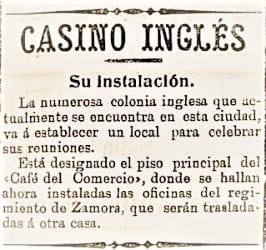
Casino Inglés was meant to be the main meeting place for the "numerous" English colony of Ferrol.
Located roughly halfway between the downtown gardens and Town Hall, it occupied an entire floor which had formerly housed the main offices of the Zamora Regiment.
The floor was completely refurbished to provide a comfortable ambience.
The British Hall had buffet service.
A week later the English colony arranged a New Year's Eve ball to celebrate the arrival of the year 1910.
The ball was held ... at the New England pavilion perhaps?
No, it was held in the posh Teatro Jofre.