On January 1 a brand new soccer team, named Shipbuilding, composed of young British employees of the Ferrolian dockyard boarded the steamship Amboage together with many local soccer fans bound for A Coruña in order to play that city's Real Club Deportivo.
They were welcomed "affectionately" upon arrival and were fêted until midnight.
On Sunday morning the British contingent paid a visit to the tomb of Sir John Moore and left "extremely gratified."
The match was played in the afternoon, 3:30 PM. Presiding the event were the British consul of A Coruña, the viceconsul, a Spanish representative of the Captain-general, the Navy commander of A Coruña, the president of the Corunnese soccer club and Mr. Vickers the director of Sociedad Española de Construcción Naval.
A military brass band interpreted the two national anthems, Marcha Real and God Save the King, before the start of the game.
At the first half whistle the score was drawn 2-2.
During the second half the wind favoured Real Club Deportivo, the team scored three goals and the match finished 5-2 in favour of the locals.
In short: a very agreeable fiesta and gorgeous weather.Before boarding the steamship Amboage for the return voyage the players were complimented with a splendid refreshment at the Gymnasium.
Upon arriving to Ferrol we have perceived that the British bring back a very good impression of Real Club Deportivo, that they wish to see these excursions happen frequently and to soon have the opportunity of inviting Deportivo to play a match in Ferrol.
(El Correo Gallego. January 5, 1910, page 2)
According to La Correspondencia Gallega, January 1, 1910, page 1, the Shipbuilding lineup of that first encounter was: S. Campbell, Wickers, Johnson, Jankin, R. Campbell, Butcher, Molley, Clark, Pratt, Hardie and A. F. Campbell.
In other news, every office and workshop of the shipyard now had a telephone line (ECG. January 17).
A zarzuela company directed by Mr. Martí's debuted at the New England theater on Sunday January 23 in front of a full house. Despite persistent foul weather the attendance ranged from good to "magnificent." The functions scheduled for Monday February 7 had to be cancelled because the roof leaked. The cracks were repaired hastily and Martí's company enjoyed a long run until Saturday March 19 when it paused to observe Holy Week. Performances resumed on Saturday March 26 and the company said good-bye shortly afterward on Tuesday March 29. The two functions of their last Sunday in Ferrol were "colossal full houses."
The stormy winter of 1910 made the news more than once. "Last night heavy showers and hurricane-force gusts followed one another continually and at times awed ... Many rooves were damaged" (ECG. January 28, 1910, page 2).
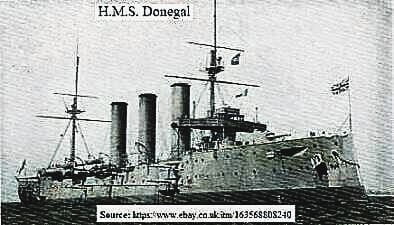
On February 19 Royal Navy cruiser H.M.S. Donegal (below, left) dropped anchor in the harbour at 9:00 AM.
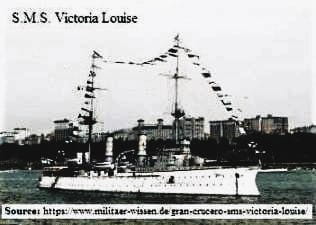
The German cruiser S.M.S. Victoria Louise (below, center) moored the next day.
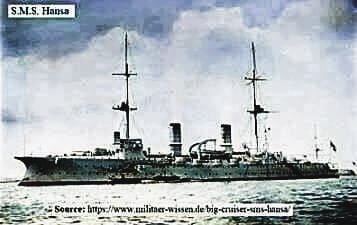
S.M.S. Hansa (below, right) joined both on the 24th.
Ernest Warmke, a coal trimmer aboard S.M.S. Hansa, died of heart disease in the morning of February 28. He was twenty-three years old, a native son of Rostok.
Since he professed the Protestant religion his corpse was driven to the civilian cemetery today at 11:00 AM.The crew of the vessel memorialized him with a precious one-meter-diameter wreath of natural flowers.
(El Correo Gallego. March 1, 1910, page 1)
H.M.S. Donegal sailed away on February 26 bound for Devonport.
S.M.S. Victoria Louise departed on March 3.
S.M.S. Hansa left port on March 10 en route to Germany.
All three vessels survived the First World War.
Teatro Jofre "faded away" on February 25 when the local power company pronounced the electric installation of the theater unsafe and locked down the venue.
On July 10 the society running the dormant theater dissolved itself and the property was donated to the Hospital of Charity. The hospital bankrolled a new electrical installation.
On Monday March 28 the English wing of the British colony played a soccer match against the Scottish wing.
Kickoff time was 5:00 PM.
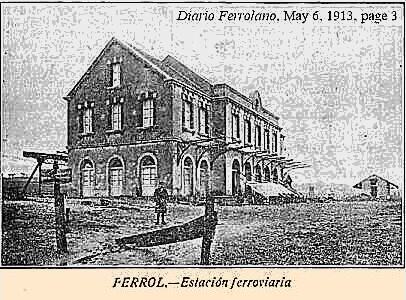
The "pitch" was a grassy field that would be available until September 20. It was declared off-limits when work started on laying down tracks and building Ferrol's first railway station (photograph on the right).
For England played Stainton, Preston, Rowe, Johnston, Charley, Vickers, Marshall, Robson, Bacon, Bettinson and Butterfield.
Note: "Vickers" was probably the same player as "Wickers" in the January 1 lineup supplied by La Correspondencia Gallega (End of Note).
For Scotland lined up McGregor, Smith, Swaney, Clark, Shearer, Gillis, Milloy, Campbell, Gowan, Wilson and Stewart (ECG. March 28, 1910, page 2).
Note: I have taken the liberty of modifying the newspaper rendition of four Scottish surnames: "Gregor" (newspaper) → McGregor, "Swerney" → Swaney, "Gillies" → Gillis and "Goant" → Gowan (End of Note).
On Sunday April 24 many people gathered in the harbour to greet the Real Club Deportivo squad, their fans and families—in all more than two hundred passengers who debarked steamship Amboage at 12:00 noon.
The welcome was "very affectionate."
The match between Shipbuilding Football Club and Deportivo began at 4:00 PM. The game was watched by a very big crowd.
At halftime Shipbuilding led 3-2.
The final score was 6-3 in favour of the locals.
The Corunnese were invited to a splendid and affectionate lunch at the English Club [i.e., Casino Inglés]...When the time came for the return voyage they were accompanied to the harbour and bidden a most affectionate farewell.The Corunnese excursionists charge us to express publicly their sincere gratitude and a thousand thank-you's to the whole British colony for the affectionate hospitality they dispensed.
Probably next Sunday the same British team will go to La Coruña for a return friendly and it's almost certain that, if the weather holds, an extraordinary voyage will be chartered to enable the entire British colony and many football fans to witness the reprise of so interesting a tourney.
(El Correo Gallego. April 25, 1910, page 2)
The team's name, "Shipbuilding," was soon changed to "Reina Victoria."
After the zarzuela company directed by Martí said good-bye on Tuesday March 29, El Correo Gallego did not report any activity at the New England until October 13, a lapse of six and a half months. On that day the newspaper advised its readers about a variety show slated for Saturday October 15.
It would appear that the pavilion had remained closed to the public for over six and a half months.
There is reason to suppose that the leaky roof of Monday February 7 was a minor component of extensive damage wreaked on the pavilion by the driving rains and fierce winds of the first three months of the year 1910 and that the repairs called for were painstakingly slow, lengthy and very expensive.
This contention is buttressed by the exorbitant prices charged for the variety show staged on Saturday October 15. The admission tickets that day cost 3 Pesetas for a chair of the first four rows, 2 Pesetas farther back, 1 Peseta for sitting on the front row of benches, 0.75 Pesetas farther back, and 0.50 Pesetas for general admission.
In former times such dear prices would imply the presentation of an expensive company of artists, but on Saturday October 15 the "artists" were "well-known British and Spanish employees of the Shipyard, Arsenal and Dry Dock" (ECG. October 13, 1910, page 2).
Clearly the pavilion had taken a serious financial hit and stood on the verge of bankruptcy.
The "Variety Concert" began at 9:30 PM sharp.
The British colony in full attended the fiesta it had itself organized.
Not a seat was left vacant and nonstop clapping attests to the joy infused by the program.
Mr. Nicholson the MC opened the show at 9:30 PM with Mr. Moffat's rendition of several jolly songs.
Mr. Symons sang with equal virtuosity.
Mr. Macmillan recited a heartfelt monologue very properly.
The tableaux vivants arranged by Mrs. Elliot and Robson were presented masterfully.
The duo Excelsior received an equally warm and enthusiastic round of applause.
The program inserted a session of flamenco songs and dances which made the delight of the British colony plus a display of magic pulled off by Agustín Burgos the distinguished amateur.
We are indeed sorry that lack of space prevents us from inserting any more details, but the fact is that the festival flooded the auditorium with good cheer.
The national anthems, Marcha Real and God Save the King, this one sung by the whole auditorium, wrapped up the night.
It would be desirable to stage so attractive and delightful shows again.
(El Correo Gallego. October 15, 1910, page 2)
Before the end of 1910 the New England faced two tough competitors.
Teatro Romea had since August been offering a daily mixture of varietés and cinematographs.
Teatro Jofre reopened on December 4 after rewiring an "excellent and splendid" electrical installation and presented a "magnificent festival" that drew a "distinguished audience including many ladies and pretty misses."
Around 1:00 AM on November 21 the body of dockyard master driller John Farrell was found dead in his boarding room.
He was thirty-eight years old, married, Roman Catholic and a native of Scotland (ECG. November 21, 1910, page 2).
He was taken at 5:00 PM the same day to the Catholic Cemetery with a cortege of British Catholics presided by Mr. Rechea (Spaniard), Mr. Campbell, Mr. Muir, master Roberts and the viceconsul in uniform (ECG. November 22, 1910, page 2).
The autopsy done at noon on November 22 revealed the cause of death to be pulmonary edema. John Farrell was buried immediately afterwards (ECG. November 23, 1910, page 2).
The British colony, "wishing to show solidarity with their fellow countrymen," agreed to stage a benefit show on Tuesday December 20 at the New England, all proceeds going to Mr. Farrell's widow and children (ECG. December 16, 1910, page 2).
The newspaper did not cover the benefit show.
Ten days later the colony notified the press about another upcoming concert in the pavilion scheduled for Saturday January 7, 1911.
"Mr. Nicholson will organize the music program and proceeds will go to the Victoria football club" (ECG. December 30, 1910, page 2).