Bellver's company terminated its contract on Sunday January 19, 1913.
Montijano's comic-dramatic company debuted for the fourth year on Saturday January 25.
On Tuesday January 28 the company presented Quintero brothers' comedy, "Puebla de las mujeres" (Women's Town),
That day's "vermouth session" (6:00 PM) sold all the tickets for padded seats. The evening session registered lower attendance figures.
On Tuesday February 4 the Montijano's comic-dramatic company staged Paul Gavault's 1909 romantic comedy, "La Pétite Chocolatière" (The Chocolate Girl).This comedy was made into a movie in 1932. Here is its title song,
La Pétite Chocolatière (1932)
At 5:30 PM on Saturday March 8 the company staged Gaston Leroux's 1907 thriller, "Le mystère de la chambre jaune" (The Mystery of the Yellow Room"). Almost all the tickets had been sold by late Thursday. The four weekend sessions were jam-packed (ECG. March 10, 1913, page 2).
Leroux's popular thriller was made into an Argentinian movie in 1947,
El misterio del cuarto amarillo (1947)
Montijano's company said good-bye on Sunday March 16.
At 9:00 PM on Saturday March 22, 1913, the "working classes" organized a festival in the New England theater.
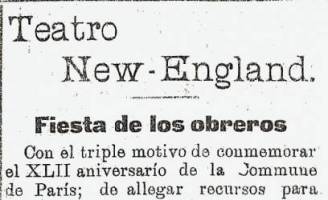
The working-class festival had a three-pronged objective, "to commemorate the forty-second anniversary of the Paris Commune, to gather funds for the construction of a People's House in Ferrol and to lend financial assistance to the Madrid journal, El Socialista" (ECG. March 24, 1913, page 1).
An enthusiastic group of amateurs put on Joaquín Dicenta's drama, Juan José.
The evening drew a "numerous" affluence of customers.
Two weeks later, on Saturday April 5, the pavilion hosted a charity function at 9:00 PM organized by Sección Artística Socialista (Socialist Artistic Section) in succour of families affected by the accidental explosion of February 25 in the neighbouring region of Asturias.
Bellver's company returned to the New England on Saturday April 26 and debuted with Pablo Luna's 1913 zarzuela, "Los Cadetes de la Reina" (Cadets of the Queen).
On Thursday May 29 the company staged Joaquín Valverde's "Los Apaches de París."
The affluence of customers was "very numerous."
Apparently Bellver's company said good-bye on Sunday June 15; the newspaper did not cover the event.
The pejorative moniker, "Apache," initially identified a tribe of savage individuals living in a civilized milieu.
Wearing a tattoo exposed Apache affiliation (ECG. January 29, 1912, page 3).
A degenerate and perverse individual clothed in elegant dress was an Apache too (Noticiero de Vigo. April 29, 1912, page 1).
Secular schools bred criminal youngsters thirteen years old or less, scattered Apache seed out in the streets (La Región. May 4, 1912, page 1).
The newly installed Portuguese Republic was a band of Apaches (El Correo de Galicia. May 14, 1912, page 1).
Eight Apaches assaulted an Italian man in Madrid, leaving him in critical condition with multiple stab wounds (ECG. September 2, 1912, page 3).
Majority members of the Hungarian Parliament insulted Opposition members calling them "Apaches" (El Regional. September 24, 1912, page 1).
Two anarchists, members of an Apache society dissolved in Marseille, were arrested in Barcelona (Diario de Galicia. December 28, 1912, page 3).
A band of Apaches desecrated more than a hundred graves in Paris (La Voz de la Verdad. January 7, 1913, page 2).
The secular school, atheist, rationalist, threatened to turn Spain into a cage of lunatics, a nursery of Apaches and anarchists, unless the crushing strength of the political Right intervened (Noticiero de Vigo. February 15, 1913, page 1).
From being a synonym of "hooligan" the label "Apache" broadened progressively to embrace anarchists, rationalists and the political Left,
The battlelines are drawn.On one side is honest Spain, the Spain of law and order, the Spain that works and progresses. On the other is the Spain of hubbub and commotion, the Spain of the wildest demagogies, the Spain which pacts with Apaches and anarchist elements abroad, the anti-patriotic, pro-Europe Spain, deprecating everything national, the Spain of the callow...
Who will obtain victory?
(El Centinela. January 19, 1913, page 3)
Joaquín Valverde's zarzuela, "Los Apaches de París," spoofs a fictional French detective who fails to apprehend two Spanish petty thieves-with-a-conscience.
The bizarre and preposterous plot seems to be merely an excuse to show off the apocryphal dance of the French Apaches or to flaunt Valverde's Apache song, translated liberally below,
The life of an Apache circumscribes the fairest delights;
He preens himself the victor while crouching in his lair.
Apaches know how to brave the stout or bold on the dare
For in a quarrel's incipent flare we put our lives on the line
And always triumph—Life waxes so dull
When no rumbling is indeed called for!
Pour more champagne and with a glass full to the brim
Of this nectar moussed I shall never taste fear.
Ah, this is our indispensable brew that fires up our senses
And woos luck in the brawl or in Love's scuffles best of all.(Quinito Valverde and Luis Foglietti. Los apaches de París. 1913: S. Velasco Printer, pages 25-26)
The real Apaches of Paris were progressively dismantled by police raids that started in early 1910 and climaxed with infantry troops and Army engineers first blowing up a garage on April 29, 1912, and subsequently a rented chalet on May 14.
"The tragic end of the Apaches has generated euphoria in Paris" (Noticiero de Vigo. May 17, 1912, page 4).
Two French movies resurrected the Apache subculture,
Casque d'Or (1952)
Apaches: Gang of Paris (2023)
The newspaper reported on Friday June 20 that the New England had switched to a continuous showing of cinematographs. The feature film that day was the 1913 blockbuster, The Count of Monte Cristo.
On Monday July 28 the theater hosted an Architecture seminar given by the president of the Corunnese Center of Culture. More than five hundred persons attended.
Montijano's company returned for the second gig of the year on Saturday November 1 and started with the familiar comedy skit, Los Hijos Artificiales in the vermouth sesion (see 1907) and Zorrilla's classic, Don Juan Tenorio, (see 1907) in the evening.
The debut was a success (ECG. November 2, 1913, page 2) and the exclusive representation of Don Juan Tenorio on Sunday brought two full houses (ECG. November 3, 1913, page 2).
On Friday November 7 the dismal weather ("heavy afternoon and evening showers followed each other almost without pause") lowered the attendance numbers (ECG. November 8, 1913, page 2).
Despite persistent bad weather, however, the New England "filled to capacity" the next day.
On November 11 at 6:30 PM Montijano's company reprised Gaston Leroux's "El misterio del cuarto amarillo" and in the evening a novelty, Antonio Casero's comedy skit, "El casado casa quiere" (A married man wants a house of his own).
The digital archive Galiciana has fifteen November days missing for El Correo Gallego. Even so, it can be affirmed with confidence that the attendance figures for the whole month of November 1913 ranged from good to excellent except on weekdays of terrible weather.
The November 25 number of El Correo Gallego reported on page 2 that Montijano's company was rehearsing "the great social drama entitled, El pan de los pobres (The Bread of the Poor)."
The digital archive Galiciana keeps only two December days for El Correo Gallego.
The copy of December 30 does not mention the New England.
The copy of December 31 states that Montijano's company left for Toledo "without having realized in Ferrol the sweet hopes its two directors harbored" (ECG. December 31, 1913, page 1). The reporter submits two reasons: the absence of a "good leading actress" and the excessive number of functions. "The company scraped through thanks to the repetition of premières and to the representations of Don Juan Tenorio, a play that always succeeds here. We wish the company better luck in Toledo."