The new year started on Saturday January 3 with a magician named "Doctor Arthur" and his assistant(s) who performed under the moniker, "Los comediantes de Lucifer" (Lucifer's comedians). Their performances were interspersed with cinematographs. They left on Sunday January 11.
The digital copies of El Correo Gallego freely accessible online ignore the New England's functions completely for the rest of January and for February.
On March 14 Elena Fons the "eminent Spanish artist" debuted at the pavilion. Although she was originally scheduled to perform two days only the pavilion managed to retain the "genial artist" a further couple of days.
Muriente's company came next.
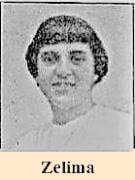
The star was the manager's daughter (photograph on the right). She performed under the stage name, Zelima, "a most refined singer and dancer and a very good-looking woman" (ECG. March 19, 1914, page 2).
During the 6:30 PM session of March 21 Zelima executed "new, admirable and artistic dances and songs, both national and foreign." Subsequently she played the female half of the "Zelima and Henry" duet (Ibid., page 2).
During the 9:30 PM session Mr. Murientes presented "some admirable experiments of auto-suggestion which will amaze the audience." Both functions interspersed live performances with cinematographs.
Note: According to Hoy.es Zelima's real name was Enriqueta Murientes. She was murdered by a jealous suitor in 1916 when she was just eighteen years old (End of Note).
The electric doll routine (May 7, 1908) made a return appearance on March 29.
The New England functions were disregarded by the newspaper from March 29 until June 9.
On June 9 the Steering Committee of the Workers Center of Culture convoked its members and all the citizens of Ferrol to an 8:00 PM conference at the New England theater.
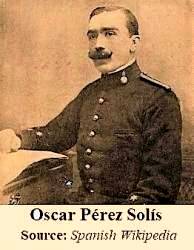
The ex-captain of Artillery, Oscar Pérez Solís (photograph to the right), was going to be the conference's chairman and give a talk on the role of culture as a means of emancipation (ECG. June 9, 1914, page 2).
Mr. Solís' dissertation probably conveyed the line expressed by V. I. Lenin in the article, "Party Organization and Party Literature," published by the twelfth issue of the Social-Democratic magazine, "Novaya Zhizn," (New Life) on Old Style November 13, 1905.
Two quotations from Lenin's article follow,
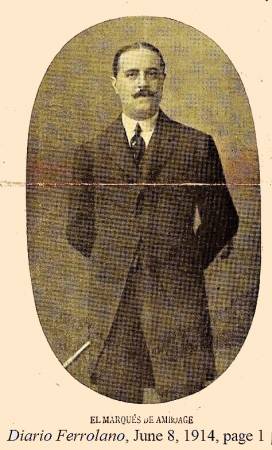
On June 11 the New England invited the Marquis of Amboage (photograph below, left) and his wife to a special function at 9:30 PM in their honour.
At 9:30 PM sharp the Marquis and his wife made their appearance on the balcony expressly installed for them inside the pavilion. The spectators who filled the place to capacity ("there wasn't enough room for a needle") cheered and hailed the pair, and these responded with "that affability and courtesy which distinguishes them."
The marquise, "radiant with beauty," wore a white crêpe dress with strawberry-coloured bow, black hat, earrings, a collar of white pearls and a wrist bracelet. She attracted the eyes of the numerous public throughout the entire evening (ECG. June 12, 1914, page 2).
The star on the stage that night was the "laureated" Ferrolian chorale, Airiños d'a miña terra.
The members of the chorale received so much clapping after each number that they were compelled to do encores. When the marquise heard their rendition of Xosé Baldomir's Meus Amores (My Loves) she expressed a wish to have the sheet music and the lyrics.
The two cinematographs shown were "gorgeous." The first one was Gaumont's 1914 production, Manon de Montmartre. The second one was "The disappearance of Mrs. Harper" (no references found).
Upon exiting the theater to return to the hotel the acclamations continued and persisted all along the route. Once in their hotel the "multitude" that was gathered outside compelled them to step out onto the balcony, from where the Marquis hailed Ferrol several times and thanked everyone present "with brief but very honed phrases."
On Thursday July 23 El Correo Gallego published an inconsequential report on the front page (!) about an aspiring artist's rehearsals at the New England. The report, though, reveals there were functions going on at the pavilion and that the newspaper neglected them all. And this attitude persisted for the remainder of the year!
Although the digital archive misses a few numbers during this period it is improbable that they carried any news about the New England until December 18.
On December 18, 1914, Town Hall notified Justo Tenreiro González that he had until January 1, 1915, to vacate the grounds where the New England pavilion was installed and to pay the outstanding property tax to the end of December (ECG. December 18, 1914, page 1).
This Town Hall notification came on the heels of "the injunction of the Most Excellent Sir Commandant-General of the Maritime Department whereby he is obligated to demolish the New England pavilion before the first of January next" (Boletín oficial de la provincia de La Coruña, 121. May 26, 1915, page 466).
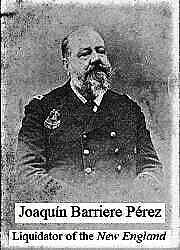
Who was this "Most Excellent Sir Commandant-General of the Maritime Department" at the time? Joaquín Barriere y Pérez (photograph to the left). He had been appointed to the post on March 13, 1913, was relieved on May 13, 1915, and died on April 10, 1921.
To cut a bureaucratic rigmarole short every attempt by Justo Tenreiro González made to relocate the New England pavilion failed. Town Hall would propose a new site but upon acquiescence by Justo Tenreiro González it would rescind the emplacement. This happened several times.
Eventually everyone realized that the New England run was finished.
Everybody knew about the revolutionary turmoil in Czarist Russia (e.g., see Collected Works of V. I. Lenin & Galiciana, Chapter 16, Item 4, news of May 16, 1913).
The New England pavilion had witnessed at least two untoward Socialist manifestations prior (March 13, 1907; February 25-26, 1911).
Barriere y Pérez witnessed two more: March 22, 1913, and June 9, 1914.
The Commandant-General must have then decided to liquidate a speaking platform of the Socialists. He used "legal" means perhaps related to the outbreak of the First World War.
Town Hall cooperated because Fermín Zelada Varela the mayor of Ferrol at the time was a Conservative.
Great Britain entered the First World War on August 4, 1914.
The Ferrolian British colony began collecting funds for wartime relief that same month.
The revenue obtained from the first month of operation was 1,500 Pesetas. It rose slightly to 1,578 Pesetas during the second. Both amounts were sent to the Prince of Wales War Relief Fund (ECG. October 25, 1914, page 1).
On December 22, 1914, the British School held its customary Christmas Tree party.
"The place was extremely crowded, for the whole resident colony gathered" (ECG. December 23, 1914, page 1).